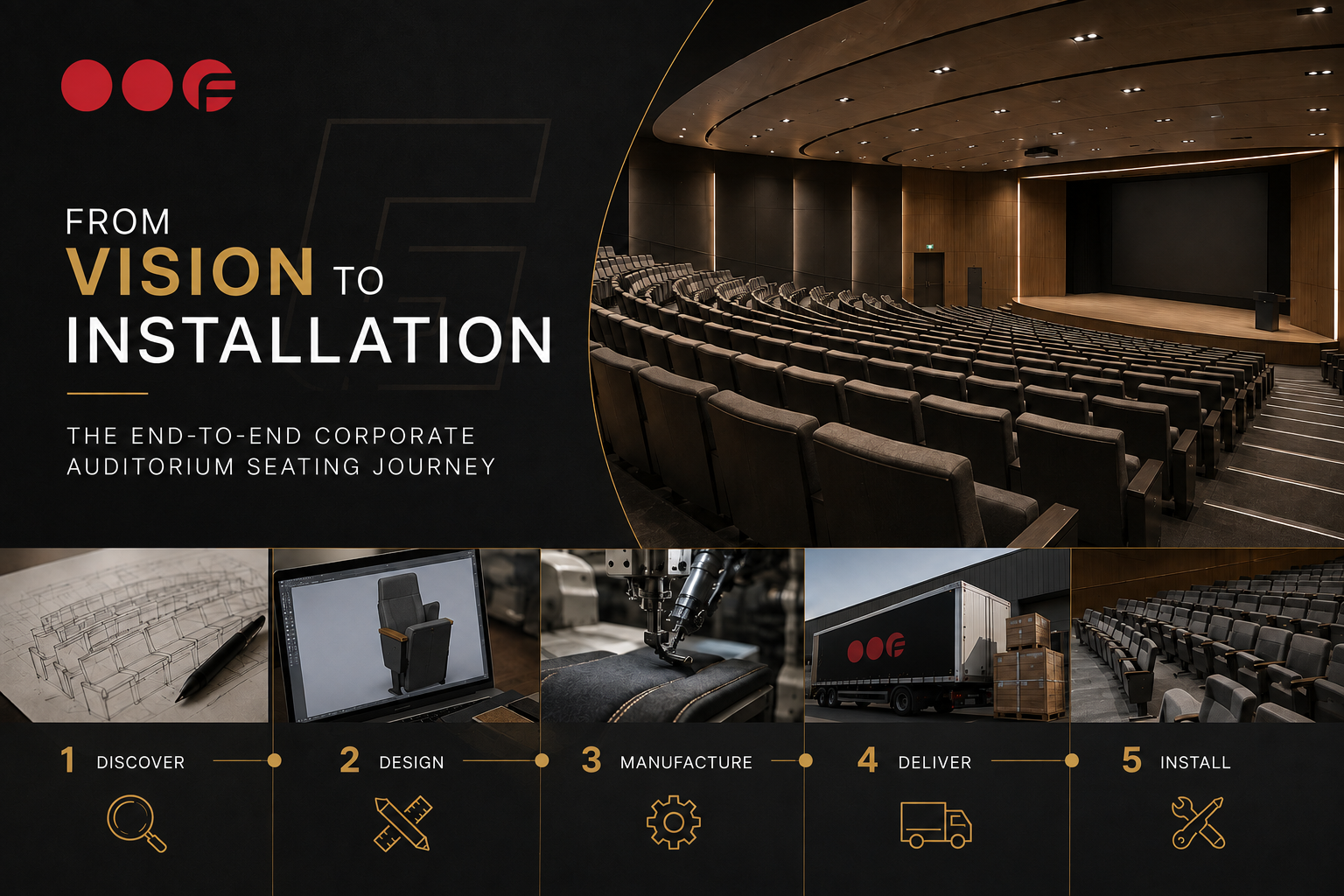
What is the corporate auditorium seating journey?
The end-to-end process from initial needs assessment through design, manufacturing, delivery, installation and ongoing service.
Custom auditorium seating projects are evaluated as part of the overall project strategy — architecture, intended use, audience profile, capacity, circulation and long-term operation — and managed across multiple stakeholders: architect, acoustic consultant, AV integrator and facility team. [3] A manufacturer’s project management capability is therefore an important part of what you are buying.
What it is not
A simple “order seats, receive seats, install seats” purchase.
Why understanding the full journey reduces risk
Most cost overruns and schedule delays in custom corporate auditorium projects originate from misaligned expectations between phases, rather than from manufacturing failure. Understanding the full journey lets you:
- Set accurate timelines and budget contingencies.
- Make specification decisions at the right phase, not after manufacturing.
- Coordinate dependent workstreams: AV, acoustic and construction.
- Evaluate manufacturers’ project management capability against your project’s complexity.
Phase 1
Needs assessment
What happens
The manufacturer’s project team works with you to audit the space and document requirements: physical measurements, sightlines, capacity, AV and power infrastructure context, acoustic baseline, ADA compliance scoping and brand specification. [3]
Key decisions
- Primary use cases: presentations, hybrid meetings, training, external events.
- AV and power coordination requirements.
- Accessible-seating count under §221 / §802 of the 2010 ADA Standards. [4]
- Brand customization scope.
Compressing the needs assessment to accelerate the timeline. Errors discovered later are more expensive to correct.
Phase 2
Design & specification
What happens
Based on the needs assessment, the manufacturer develops the technical specification: configuration layouts, materials, finishes, AV and power coordination schematics, ADA documentation and visual renderings.
Made-to-Measure projects
For projects using Figueras’s Made-to-Measure programme, the design department works directly with the architectural team to bring the concept to a buildable specification. [1]
Key decisions
- Final model and configuration selection.
- Materials, colors and finishes, ideally reviewed with physical samples.
- AV and power coordination sign-off, jointly with your AV integrator.
- Acoustic parameters confirmed with the acoustic consultant.
Approving the specification without your AV integrator’s review.
Phase 3
Manufacturing
What happens
Following specification sign-off, manufacturing begins. Custom components are produced to the approved specification.
Key decisions
- Approval of any specification clarifications raised during production.
- Coordination of delivery logistics with facility management.
- Confirmation of the installation schedule and phasing plan.
Treating manufacturing as a passive waiting period. Client-side preparation during this phase determines whether installation runs on schedule.
Our project team can walk you through every phase and its lead times.
Phase 4
Logistics & delivery
What happens
Manufactured components are shipped and staged at the project site, including any required freight, customs and last-mile coordination.
Key decisions
- Site access schedule with building management.
- Component staging and storage.
- Installation team schedule.
Handling delivery logistics in isolation from the manufacturer. Staging errors for large-scale custom components create installation delays.
Phase 5
Installation
What happens
The installation team executes the layout. For corporate auditoriums inside active buildings, installation is typically phased to minimise operational disruption.
Key decisions
- Phase sequencing and schedule with building management.
- Resolution of any site condition variances.
- AV and power integration testing at each phase.
Scheduling installation without accounting for building constraints: noise hours, loading dock access, elevator capacity.
Phase 6
Aftercare & lifecycle service
What happens
Following installation, the manufacturer provides warranty coverage, maintenance documentation and ongoing technical support. Figueras describes its lifecycle service programme as a customer-service programme covering ongoing attention over the seating’s life. [2]
Key decisions
- Registration of warranty coverage and documentation.
- Training of facility management on seat operation and maintenance.
- Maintenance schedule for mechanical components.
Treating post-installation aftercare as an afterthought. Replacement-parts availability and response time matter when components require servicing.
Most delays do not start in the factory. They start with decisions taken in the wrong phase.
— Figueras Seating
The journey at a glance
| Phase | Key output | Who leads |
|---|---|---|
| 1. Needs assessment | Documented requirements | Manufacturer + client |
| 2. Design & specification | Approved technical specification | Manufacturer + architect / designer |
| 3. Manufacturing | Completed production run | Manufacturer |
| 4. Logistics & delivery | Components staged at site | Manufacturer logistics team |
| 5. Installation | Completed installation and integration testing | Manufacturer install team |
| 6. Aftercare | Warranty coverage and service [2] | Manufacturer aftercare team |
Frequently asked questions
How long does a custom corporate auditorium seating project take?
Lead time depends on customization scope, project complexity and installation phasing. Request a written lead time and milestone schedule from each manufacturer.
At what phase should the AV integrator be involved?
From Phase 2, design and specification, so that AV and power coordination is compatible with the existing infrastructure.
Can the project timeline be compressed?
The earlier phases have limited compression potential: errors there are expensive to correct later. The most reliable way to accelerate overall delivery is to begin procurement planning earlier in the facility project timeline.
What happens if a specification clarification is needed during manufacturing?
It should be flagged to the client immediately and resolved before production continues. Ask each manufacturer to describe their mid-production quality-control process.
What does Figueras’s Life Cycle Service include?
Figueras describes Life Cycle Service as an ongoing customer-service programme intended to support durability and responsible, cost-effective decisions over the seating’s life. [2] Discuss specific warranty terms and replacement-parts availability with Figueras at the specification stage.
Three actions to take now
If you only do three things:
- Map the six-phase journey before committing to any project schedule.
- Confirm that your manufacturer documents project management responsibilities across all six phases.
- Involve your AV integrator and acoustic consultant during Phase 2, design and specification. [3]
Let’s talk about your project
Our team supports you across all six phases: needs assessment, specification, manufacturing, logistics, installation and aftercare.
References
- Figueras. Customized Products — Made-to-Measure. figueras.com/customized-products
- Figueras. Life Cycle Service. figueras.com/life-cycle-service
- Figueras. FAQs — Approach & Decision-Making. figueras.com/seating-faqs-approach-decision-making
- U.S. Access Board. 2010 ADA Standards for Accessible Design — §221 Assembly Areas and §802 Wheelchair Spaces. access-board.gov/ada