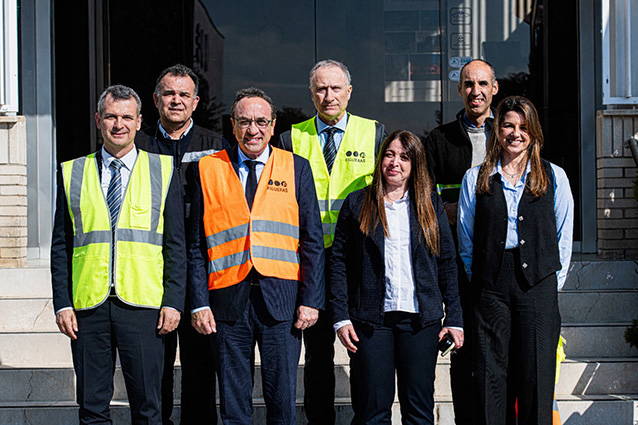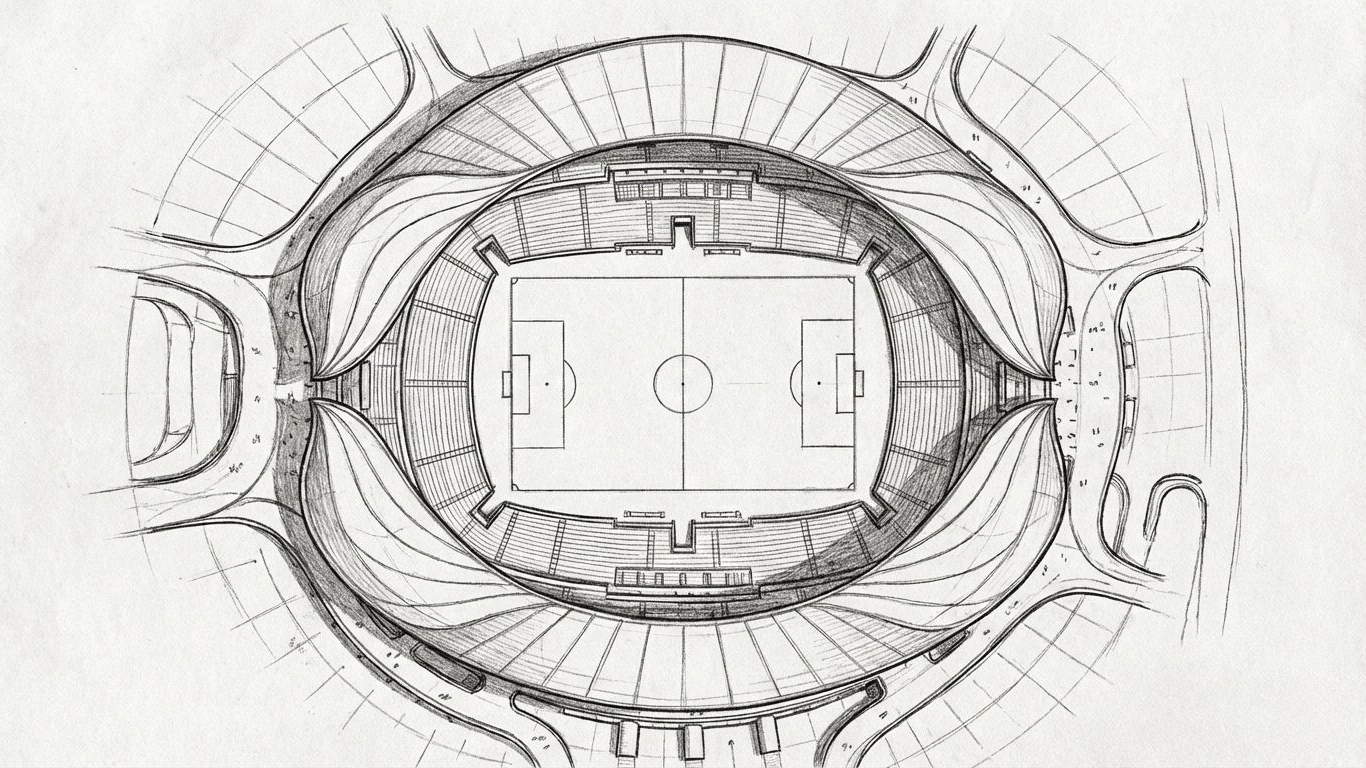
Sports architecture does not advance through blueprints and calculations alone; it also evolves through a shared vision that challenges the status quo. The second edition of the Sports World Congress, held on February 2nd and 3rd in Barcelona, has established itself as a vital space for reflecting on sports architecture in its broadest sense.
Hosting events of this magnitude is essential for our industry, as they open up spaces for debate that transcend theory to address operational reality. It is at this crossroads between institutions, architects, engineers, and regulatory bodies where inspiration is born, strategic connections are forged, and the evolution of the venues we will inhabit in the coming decade is driven.
With the 2030 World Cup (Spain-Portugal-Morocco) acting as a catalyst, the industry faces a paradigm shift: the transition from the stadium as a static monument to the stadium as a living infrastructure and a profitable urban node.
At Figueras Seating, we wanted to capture the most relevant lessons from the leaders who are redesigning the global sports map, whom we had the pleasure of listening to during the conferences at the Sports World Congress 2026.
Identity vs. Standardization: The Rise of Vernacular Architecture
The industry has reached a global consensus: the “spaceship-stadium” model—based on generic structures disconnected from their surroundings—is obsolete. Design in the next decade is moving away from standardization to embrace a vernacular architecture that is also technological. As Alex Thomas (HKS) noted, “a standard bowl with a wrapper no longer serves us,” arguing that architecture must be based on deep research into local culture, materials, and climate.
This approach is not just an aesthetic choice; it is a strategic financial asset. Cultural identity and “memorability” are key to attracting international artists and tourists, and generating demand. In the words of Sergi Roca (HKS), the goal is to create a “one-to-one solution” where the building only makes sense in that specific city and for that specific team.
However, the application of this identity varies drastically depending on the geographic and constructive context:
-
European “Urban Surgery”: Unlike the tabula rasa of other regions, the challenge in Europe is integration into established urban fabrics. The new Santiago Bernabéu exemplifies this complexity. Jordi Alcaine (Arup) explained the challenge of placing a 50,000-square-meter envelope in a densely populated area of Madrid.
-
The Stadium as a “Good Neighbor”: Moving beyond the isolated venue, firms like Batlleiroig propose “merging city and nature.” Diego Rodríguez (IDOM) reinforced this idea, stating that architecture must prioritize urban development and “be good neighbors with the surroundings,” leaving a legacy that goes beyond the sporting event. This implies integrating the building into regional mobility plans and generating civic activity 365 days a year.
-
Permeability and Lightness: While the SoFi Stadium led the way with a roof that breathes with the climate, projects in Spain like the remodeling of the Gran Canaria Stadium (“La Nube”) bet on visual lightness. Guillermo Gusó (L35) stressed the responsibility of designing scalable infrastructures that avoid the “white elephant,” allowing the stadium to adapt to major world events and then return to an optimal operational size.
Differentiation based on context, whether through the use of local materials or passive design strategies, is now a technical requirement. The goal is to move from facades that act as closed walls to envelopes that function as dynamic filters, capable of ventilating, protecting, and, above all, coexisting in harmony with the residential city.
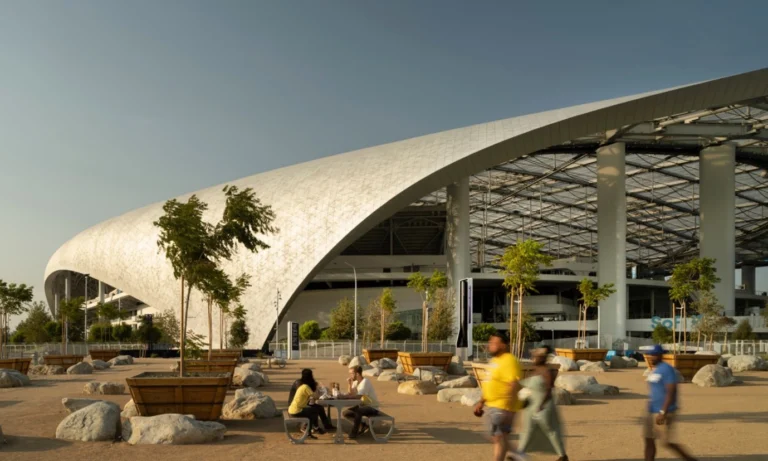
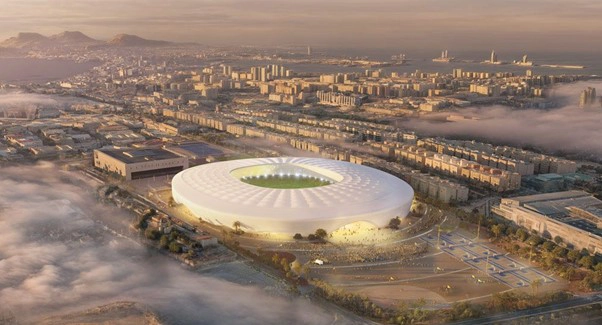
SoFi Stadium, HKS © & La Nube, L35 Arquitectos ©
The Stadium as an Urban Node
In the core of contemporary design, profitability analysis has become a technical coefficient as critical as structural integrity. It is no longer possible to project sports architecture without a clear Return on Investment (ROI) strategy. From this perspective, a stadium that only operates on match days is perceived as a toxic asset. As Antonio Dávila (RCD Espanyol) emphasized, venues must be thought of for use every day of the week, not just for a weekly event.
The technical response to this challenge is true multifunctionality. Sergi Roca (HKS) validated this model by citing the SoFi Stadium, which integrates a 6,000-seat theater under the same structure as the 80,000-seat main stadium. Achieving this coexistence requires planning where, according to Alex Thomas (HKS), the design responds to a business plan and an event calendar established prior to the architecture.
This business logic transforms urban and operational planning on four fronts:
-
Regional Ecosystems: The stadium acts as an anchor piece for active districts. Konstantinos Chatzimanolis (Nottingham Forest) described how phase two of their project includes a regeneration master plan with mixed uses and hotels. Similarly, Tayomara Gama (Gensler) explained that the project they are carrying out in Giza integrates a university, hospital, and school to guarantee a constant flow of people.
-
De-escalation Strategy: To avoid the dreaded “white elephants,” life after the big event is planned. Guillermo Gusó (L35) used the Gran Canaria Stadium as an example, where expansions of +10,000 spectators have been designed for world events that can later be removed to recover the stadium’s optimal and usual operational scale.
-
The End of the “Anchor Tenant”: Viability lies in versatility. Tom Flanagan (AEG) highlighted that the O2 Arena in London operates without a resident team, achieving 239 nights of content annually. Meanwhile, Nancy Johnson (Roig Arena) presented a 100% private investment model with a 50-year concession in which the arena has already sold one million tickets before being six months old. In this scenario, furniture evolves from a passive element to a dynamic management tool. For example, installing mobile systems allows for reconfiguring capacities and uses in real-time, maximizing yield per square meter according to the event.
-
The “Livestock” Concept and the Architecture of Emotion: To compete with domestic comfort, the stadium must offer an unparalleled ritual. Salvador Alonso (FIA) defined stadiums as “incredibly emotional buildings” where a ceremony must be created to justify attending in person. Diego Rodríguez (IDOM) reinforced this point: “we come to be together… if the architecture does not facilitate the public seeing themselves as a community, the ritual loses its value.”
The Regulatory Framework and the Regulatory Transition towards 2030
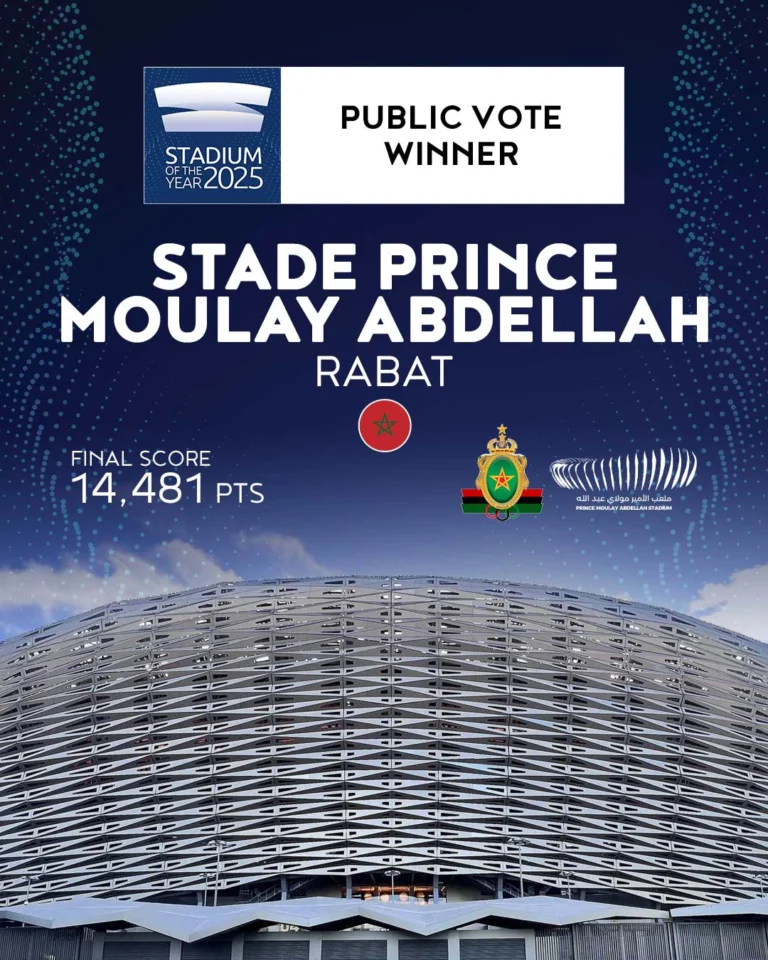
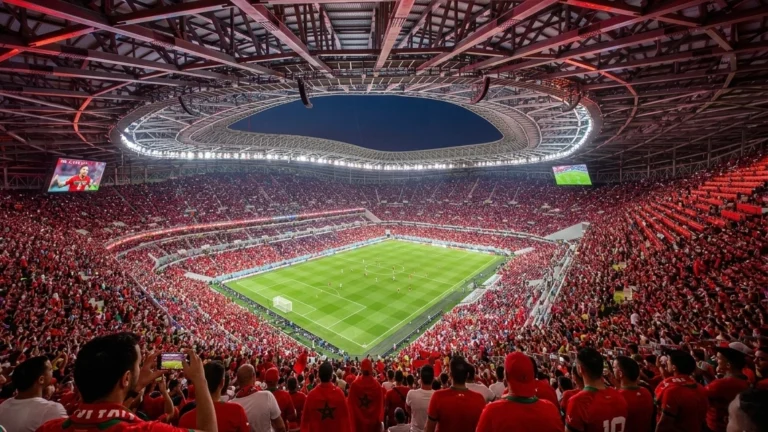
The current design of sports venues is in an accelerated regulatory transition phase, driven by the so-called “2030 Effect.” As noted by Oriol Capelleras (PMO at Figueras), stadiums such as those in Morocco are already positioning themselves as world leaders by strictly complying with FIFA requirements for the 2030 World Cup.
This regulatory horizon has forced managers to update their infrastructure following the recent update of the UEFA Stadium Infrastructure Regulations 2025. This new operational reality is built around three critical pillars that are redefining the anatomy of the first tier of stands and common areas:
-
Athlete Safety and Health: Requirements in playing perimeters are being tightened to minimize risks. Pietro Chiabrera (UEFA) stressed that “without taking care of the players, we would not enjoy a beautiful spectacle.” In this area, UEFA has defined mandatory minimum distances between field lines and any vertical obstacles. Chiabrera warned about the danger of serious accidents and the lack of compliance in stadiums where the dimensions of the turf or its surroundings do not respect UEFA and FIFA regulations.
-
Feminization and Inclusive Design: The “women’s football boom” and the universalization of sports have caused a drastic change in stadium demographics. UEFA is promoting the adaptability of facilities, requiring a reconfiguration of sanitary and family hospitality services. Chiabrera explained that during the Women’s Euro, creativity was needed—such as changing the direction of bathroom signage—to adapt stadiums originally designed for a predominantly male audience. Furthermore, the UEFA Access for All Guide has been updated to ensure the spectator’s journey is fluid for everyone, eliminating physical barriers like the lack of ramps.
-
Safe Standing: Reintroducing standing areas is a growing demand from fans to “improve the atmosphere.” However, UEFA applies the “safety first” principle. The risk of spectators standing in conventional seating areas is high because, according to Chiabrera, “the risk of progressive crowd collapse is truly high” if someone pushes and there are no proper barriers. A clear set of requirements to allow the safe use of these standing facilities is expected by the end of the current season (May/June).
Micro-segmentation and the Phygital Era
The premise defined by Alex Thomas (HKS) by stating that “it’s about starting with people, not plans,” implies deep demographic research prior to design. The industry has understood that a standard user does not exist. According to Thomas, it is vital to understand the culture and local behavior of each city before designing.
This reality has driven the creation of a graduated inventory. Thomas explained that the traditional division of GA, VIP, and VVIP is no longer enough; instead, “different offers and types of experiences” must be created to attract recurring visits. Tayomara Gama (Gensler) took this to operational detail, mentioning that in their projects they have designed up to “18 or 19 different products” after speaking with all user groups, from fans to the most exclusive VIPs.
For the architect, this implies designing flexible zoning where furniture plays a crucial role. Modular solutions like the new Figueras sports seat, Chronos, allow a general stand to evolve into a hospitality area by adding components (upholstery, armrests, and other accessories) onto the installed technical base, responding to market demand while maintaining aesthetic coherence in the model installed throughout these areas of the venue.
Furthermore, this physical segmentation is intrinsically linked to a digital transformation of the business:
-
Advance Sales: The success of the Roig Arena, which sold “one million tickets” before being on the market for six months—generating business even with the building still under construction—validates this strategy. Nancy Johnson (Roig Arena) confirmed that 3D technology was “really useful” for marketing the venue and for promoters to understand the project before its opening.
-
Mobile-First Design: The trend is to eliminate any friction. Sorin S. (Manchester United) stressed that his priority is for fans to be able to navigate “smoothly and without friction” through the web. For his part, Francis Casado (3D Digital Venue) pointed out that post-pandemic habit changes require the user to have everything “at their fingertips.” To this end, digital replica technologies allow the user to “live” their seat before buying it, integrating ticketing and hospitality into a unique experience.
Digital Twins and Visibility Engineering: Data as Infrastructure
Technology has ceased to be a design support to become the operational standard upon which the viability of a project is built. Currently, the implementation of a Digital Twin allows for synchronous coordination of all actors on the same living model. As Toni Durán (Batlleiroig) stated, “digitizing the asset is an asset in itself,” as it opens the door to simulations and data-based analysis that impact the building’s entire lifecycle.
This methodology guarantees a resilient and integrated infrastructure. Óscar Liébana (FCC) stressed that, without these collaborative tools and models, it would be “absolutely impossible” to undertake the complex projects being designed today, especially with current construction deadlines.
The real value of data manifests in two critical areas for the project manager:
-
Fabrication and Precision: The complexity of modern envelopes makes manual adjustment unfeasible. In the case of the Santiago Bernabéu, its 13,500 metallic slats are all different, which according to Óscar Liébana (FCC) “can only be undertaken today with digital fabrication.” Data traceability allowed for working with virtual models that went directly to fabrication “without blueprints,” guaranteeing precision in massive mobile systems like the retractable roof.
-
Simulation Engineering: The use of advanced algorithms allows for predicting the stadium’s behavior before its construction. Jordi Alcaine (Arup) explained how they used a “digital wind tunnel” to ensure that, by covering the Bernabéu, the 80,000 people inside could breathe correctly and smoke evacuation criteria were met. Likewise, light simulations were carried out to identify and correct potential glare problems in surrounding traffic and housing due to the use of stainless steel on the facade.
The strategic challenge lies in the continuity of information. As Toni Durán (Batlleiroig) noted, these models must serve not only for construction but also for the preparation of future maintenance. It is vital to “include the client in the use of these virtual models” so that the data generated during the work feeds into the daily energetic and operational management of the venue once built and operational.
The Roadmap towards the 2030 Horizon
The Sports World Congress 2026 leaves us with an undeniable certainty: we have reached what the organization defined as the “point of no return” towards the 2030 horizon. The success of a stadium in the next decade will no longer be measured by its visual audacity in a render, but by its operational resilience and its capacity to generate profitability far beyond the 90 minutes of play. The venue of the future must be, above all, an urban “good neighbor,” an uninterrupted financial engine, and a benchmark for inclusive safety.
En this ecosystem, as our PMO Oriol noted, the seat stops being a commodity to become the “physical connection with the stadium”, the most critical contact point between macro-architecture and the fan’s micro-experience. This “knowledge engineering” is what allows design to become quality time for the user.
At Figueras Seating, we understand that our work must respond to the premise of “starting with people, not plans.” Our engineering does not just comply with regulations or comfort; it aligns with the club’s business strategy to maximize the performance of every square meter. Whether through mobile systems that reconfigure capacities in minutes or high-end VVIP customizations, our commitment is to be the technical piece that ensures the transformation of the sports model is, above all, human, profitable, and memorable.